

If you are new to investing, the choices available to you can easily feel overwhelming. Conversely, if you are an experienced investor, you have likely used a few different approaches before. Either way, they are worth discussing, not just from a math perspective, but also in terms of how each strategy aligns with your personal money habits.
Imagine you won a $1 million lottery. The organizers offer you two choices: a single lump-sum payment today or fixed payments spread out over a set number of years. Both options come with pros and cons. While the goal here is not to debate which choice makes the most money in the end, it is important to recognize that each path provides unique benefits and drawbacks. Comparing lump-sum investing to dollar-cost averaging requires looking through that same lens.
What is the lump-sum strategy?
Lump-sum investing is exactly what it sounds like: taking a set amount of money and investing it all at once, for example, at the beginning of the year. While this strategy can be used at any point, let’s assume for illustration purposes that this lump sum represents all the money you will invest for the entire year.
If you were to invest $15,000 at the start of the year in a specific index fund or stock, you would purchase however many shares that $15,000 could buy. To keep the math simple, if you bought a stock priced at $100 per share, your initial capital would buy exactly 150 shares.
What are the benefits of lump-sum investing?
Mathematically, the benefits of lump-sum investing are well documented.
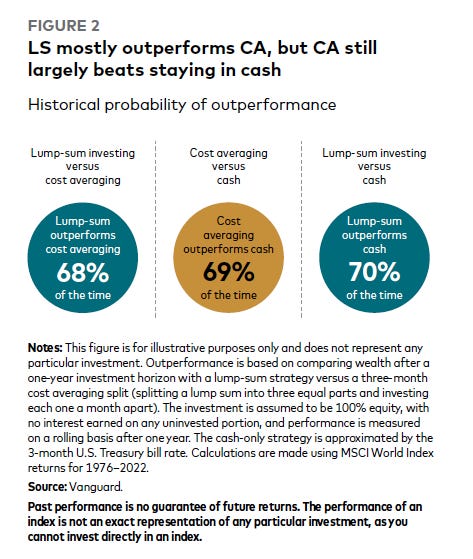
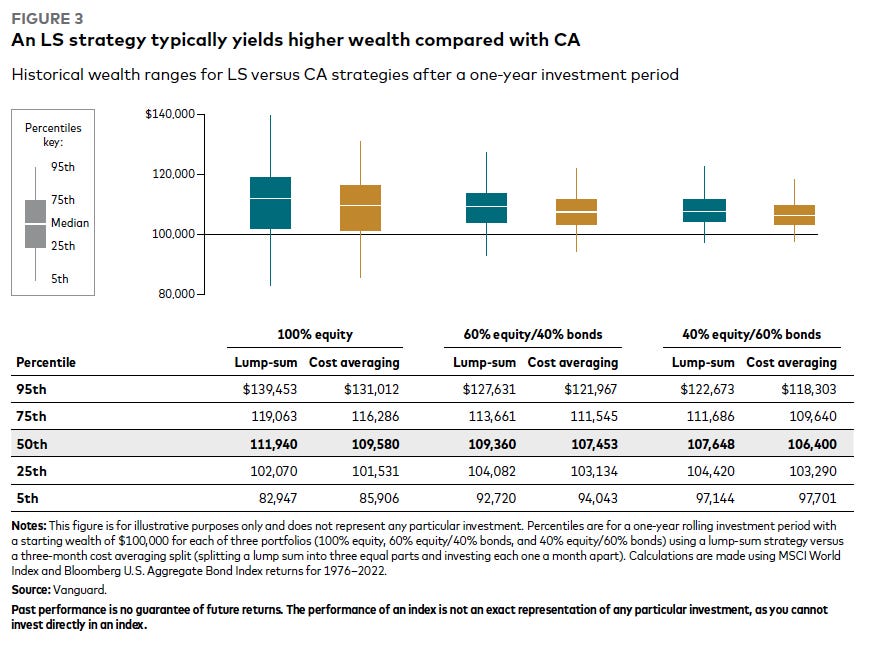
Source: Finlay, Megan and Zorn, Josef (2023). Cost Averaging: Invest Now or Temporarily Hold Your Cash? Vanguard. https://investor.vanguard.com/investor-resources-education/online-trading/dollar-cost-averaging-vs-lump-sum
According to a Vanguard study, lump-sum investing outperforms dollar-cost averaging 68% of the time. This aligns well with core investing principles. Investing a lump sum immediately exposes your cash to more time in the market, maximizing the power of compound interest. This material advantage applies regardless of how you split your portfolio between stocks and bonds.
Furthermore, lump-sum investing can signal a strong personal commitment to a long-term strategy. Committing a large sum of money all at once, regardless of what “large” means to you, takes courage. Generally speaking, investors who are comfortable taking this step are less vulnerable to anxiety during market downturns.
To illustrate, let us look back at the $15,000 example. If you purchased the stock at $100 per share at the beginning of the year and the market trended upward to $115 per share, your investment would grow to $17,250. Buying the stock at a lower price point, you fully reap the mathematical rewards of lump-sum investing.
What are the drawbacks of lump-sum investing?
The benefits of lump-sum investing rely on the assumption that the market will continue to grow upward. However, markets tend to ebb and flow. The inherent risks here are market volatility and timing.
Using the same scenario, if the stock price drops to $85 per share, your original $15,000 investment would decline to $12,750. Instead of buying at a low entry point, you would have purchased the stock at a high point. Consequently, lump-sum investing relies heavily on timing; executing it successfully requires a careful entry strategy to avoid a big drop.
While this example focuses on a single stock, investing in an index fund offers a different dynamic. Although the fund’s price may still decline, its built-in diversification is explicitly designed to handle market downturns better than an individual stock. Individual stocks naturally carry a much higher risk profile.
What is dollar-cost averaging?
Dollar-cost averaging, commonly known as DCA, is an investment strategy where you contribute a fixed amount of money at regular intervals, such as monthly, regardless of market conditions. For example, consistently investing $200 every month is a classic application of DCA.
The graphic below illustrates this strategy:
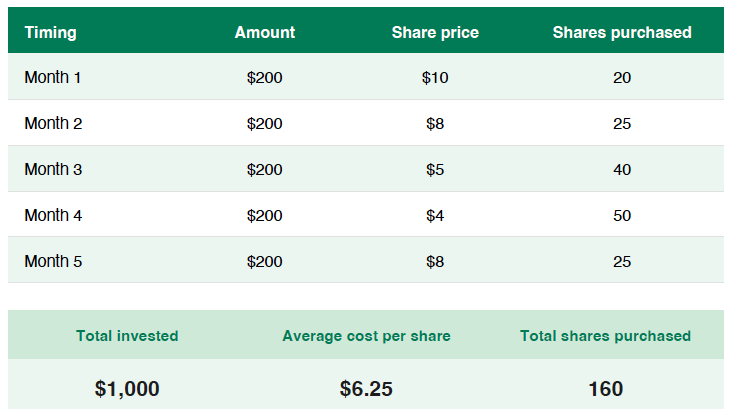
This hypothetical example is for illustrative purposes only and does not represent the performance of any specific investment.
As the strategy demonstrates, making consistent, month-over-month contributions allows you to acquire the same investment at various price points. For instance, you might purchase shares at $10 in one month, but at $4 or $5 in subsequent months.
What are the benefits of DCA?
From a strictly mathematical standpoint, DCA lets you buy more shares of an investment when its price drops. For example, your $200 investment in month three buys 40 shares at $5 per share, compared to only 20 shares in month one when the price was $10. If you had put that whole $1,000 in as a lump sum in month one at $10 a share, you would have ended up with 100 shares. By using DCA instead, you walk away with 160 shares.
Assuming this investment grows over the long haul, DCA wins in this scenario. Granted, this is a tiny sample size and leaves out a lot of real-world variables, but it shows the “method to the madness” behind the strategy.
Even though the math can work out great in a down market, the real benefit of DCA is psychological. The math matters, of course, but the stock market can be scary, and plenty of investors worry when prices drop.
DCA helps take the emotion out of the process. Because you invest a set amount every month, you buy into the market no matter what it is doing. Automating your investments takes away the pressure of trying to guess the perfect time to buy. Plus, you will naturally buy shares at a lower price during down months. If the stock market behaves as it has in the past, sticking to this routine gives you a great chance of seeing positive returns over time.
What are the drawbacks of DCA?
The downsides of DCA are essentially the flip side of the benefits of lump-sum investing. Because DCA spreads your money out over months or years, your cash does not go to work right away. This creates a potential opportunity cost. As the old saying goes, it is about “time in the market, not timing the market”. Gradually investing your money means you have less total time in the market.
As mentioned earlier, research shows that DCA usually produces lower long-term returns than a lump sum, meaning your final portfolio balance will likely lag. Finally, fees can add up depending on where you invest. Making frequent monthly moves instead of one big purchase can lead to higher trading costs, depending on your investment type and the broker you use.
Let’s bring it all together
At the end of the day, both approaches have clear advantages and disadvantages. Both are excellent strategies, but the right one generally depends on your current financial situation and your personal money habits.
If you understand how the markets work, feel comfortable taking on risk, and have a large amount of cash ready to go, lump-sum investing is a fantastic choice. The data shows that this approach will likely yield higher returns over the long haul.
On the other hand, if you are nervous about market drops, are still learning the basics, or don’t have a large pile of cash sitting around, DCA is likely your best bet. The potential for higher returns with a lump sum does not mean much if the strategy causes you constant stress.
The main goal is simply to start investing and stick with it. If dollar-cost averaging is what keeps you in the game, missing out on a little bit of extra return is a reasonable trade-off. A slightly smaller return will always beat not investing at all.
*This is not meant to be investment advice and is for general information purposes only.
Did you know?
Something to ponder…
Are you team lump-sum or team DCA? What factors influenced your choice?
Need help deciding between lump-sum and DCA? Schedule a free consultation with Texel Compass and we’ll guide you through the decision process.