

Investing has become easier over time. The growing popularity of low-cost ETFs and mutual funds makes investing in your future more streamlined than ever.
Yet, with ETFs and mutual funds, there is still an element of rebalancing and recalibration from time to time. While custodians offer automated rebalancing these days, as you get closer to retirement, your asset mix will likely shift from mostly stocks to mostly bonds due to the risk tolerance in your older age.
For those who want an even simpler model, there are target date funds.
What is a target date fund?
A target date fund is a fund built around the year you plan to retire. If you want to retire in 2055, you look for a fund with 2055 in the name.
Inside a target date fund, you will find a diversified mix of stocks, bonds, and sometimes cash. What makes it unique is the glide path, which is the automatic shift in asset allocation as your retirement date approaches. Early on, the fund is heavily weighted toward stocks, which carry more risk but offer more growth potential over time. As you get closer to retirement, the fund gradually shifts toward bonds, which are less volatile and produce more predictable income. Over time, the fund rebalances itself automatically.
It is a “set it and forget it” type of investment, and is useful for those who don’t want to think too much about their investments.
How does the glide path work?
Early in your career, say, 30 or 40 years from retirement, a target-date fund might hold 90% stocks and 10% bonds. That aggressive allocation gives your money time to grow and recover from any market downturns. As you approach retirement, the formula shifts. By the time you are five to ten years out, the fund may hold 60% bonds and 40% stocks. By retirement, it may be even more conservative to hold a higher percentage of bonds compared to stocks.
The idea is that when you are younger, you want to build as much growth as possible. The main way to accomplish this is by investing in the stock market. Hypothetically, a stock’s growth potential is infinite. While in reality there are factors that ultimately cap growth, its return potential is far greater than that of bonds.
In comparison, bonds are debt instruments that companies and governments (both federal and municipal) use to raise capital. Someone who buys a bond is essentially lending money to those entities. The cost of borrowing the money reveals itself in the interest rate (or coupon rate). The entity must pay back the principal amount of the money borrowed, plus the interest rate.
There are different grades that are assigned for different bond issuers and the bonds themselves. For example, the United States has historically been considered one of the most reliable bond issuers in the world. However, all three major rating agencies have now downgraded U.S. debt at some point, most recently, Moody’s in May 2025. Citizens from other countries and countries themselves invest heavily in U.S. bonds due to their almost zero default risk. All of this to say that bonds are a lot less risky than stocks. As you age, you’re likely unwilling to take on the risks of a heavy stock portfolio and risk a downturn in the market that would put your portfolio upside down.
The glide path illustration below, from Schwab Asset Management, shows how a typical target-date fund shifts its allocations over time.
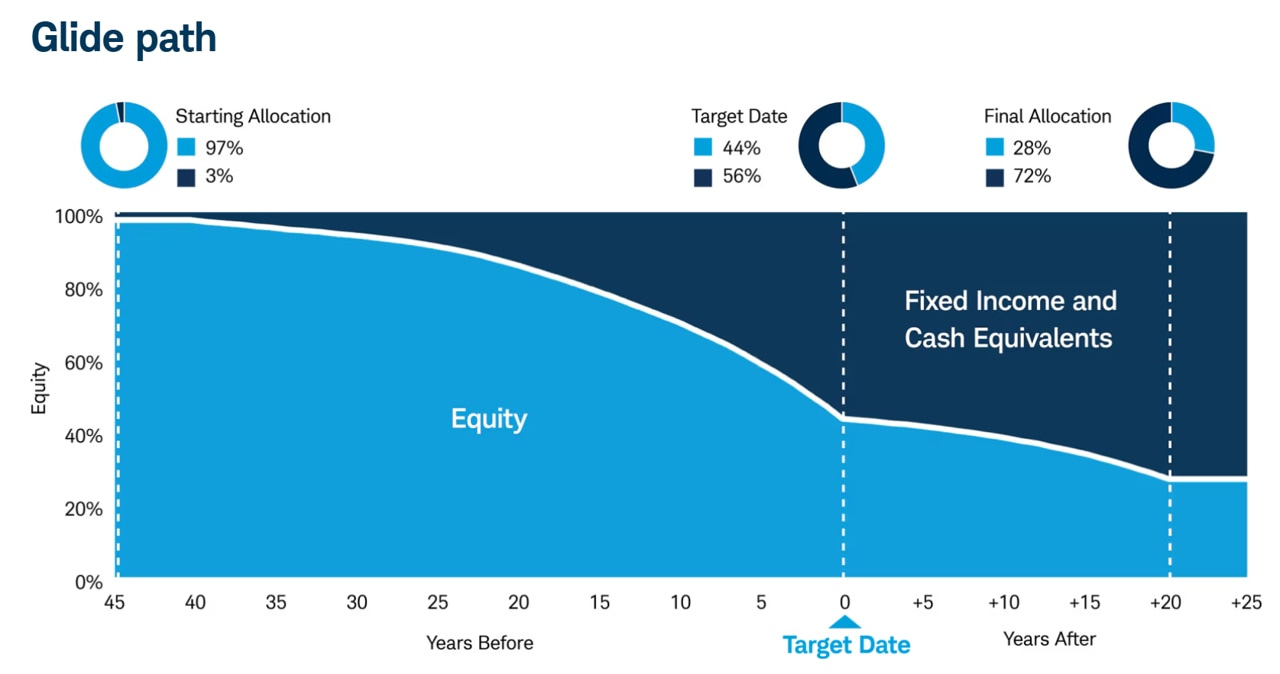
*Source: Schwab Asset Management. This hypothetical example is for illustrative purposes only.
Active vs passive target date funds
Not all target date funds are the same. Some are actively managed, where a team of portfolio managers makes decisions about which securities to hold and when to rebalance. Others are passively managed. They simply track an index (e.g., S&P 500) and automatically adjust allocations according to a predetermined formula.
The cost difference between the two can be significant. According to Morningstar’s 2025 Target-Date Strategy Landscape, index-based target date funds have expense ratios averaging 53 basis points lower than actively managed ones. Over a 30-year retirement savings horizon, that difference in fees compounds into a significant amount of money.
As for performance, the picture is more nuanced than the industry often suggests. Most actively managed target date funds do not consistently justify their higher costs. There are exceptions, as certain fund families have outperformed their passive peers net of fees over long periods, but they are generally the exception, not the rule. Higher costs do not reliably translate to better returns.
A word of caution
Not all target date funds with the same year in the name are built the same way. Two 2055 funds from different fund families can have very different glide paths, very different underlying holdings, very different expense ratios, and very different risk profiles. Before investing in a target date fund, you should understand what the portfolio is comprised of.
Another aspect to consider is that your retirement date may change. Your income may change significantly. Your risk tolerance may evolve. A target date fund does not know any of that. It just follows its own formula. That formula may or may not still be right for you ten years from now.
Do target date funds tax-optimize?
While target date funds have their upside, the downside is that they are not tax-efficient.
Specifically, target date funds do not use tax loss harvesting. Tax loss harvesting is the strategy of selling positions that have declined in value to offset capital gains elsewhere in your portfolio, reducing your overall tax liability. Target date funds do not pay attention to tax consequences, as they follow a predetermined rebalancing schedule without regard for your individual tax situation.
For most people investing through a 401(k) or IRA, this is less of a concern since those accounts are already tax-advantaged. But for those with taxable investment accounts or significant income complexity, the lack of tax optimization in target date funds is a real limitation worth considering. If tax efficiency matters to you, a more tailored investment strategy will likely serve you better.
Adjusting your target date for more or less risk
One thing worth noting: you are not locked into the fund that matches your exact retirement year. If you want a more aggressive allocation than your target date fund currently offers, you can select a fund with a later date. A 2065 fund will hold more stocks than a 2055 fund, even if you plan to retire in 2055. Conversely, if you want a more conservative allocation, select an earlier date.
This is a simple way to customize your risk level within the target date fund structure without having to build a portfolio from scratch.
Is a target date fund the right move?
I generally prefer index funds for their lower costs, greater flexibility, and tax optimization potential. For most founders with good financial habits and access to a financial advisor, there are better options than a target date fund.
That said, I don’t think target date funds should be cast out altogether. They can serve an important purpose, which is tied mostly to the psychology of investing.
Here is my general framework for thinking about whether a target date fund is right for you:
If you struggle with checking your portfolio constantly, making emotional decisions when the market drops, or consistently following through on rebalancing, a target date fund helps remove those temptations. It invests for you, rebalances for you, and shifts your allocation over time without requiring you to do anything. If that structure helps you stay invested consistently and avoid some potentially self-destructive investment behavior, the slightly lower returns relative to a well-managed index fund strategy may be worth it.
If you have strong financial habits, work with an advisor, and want more control over tax efficiency and asset allocation, you will likely do better with a more tailored strategy.
For founders specifically, the simplicity argument should not be ignored. Running a business is consuming, and personal finances often become an afterthought. A target date fund removes one more decision from your plate. But working with a wealth manager can solve that same problem while also giving you better tax efficiency, more flexibility, and a strategy built around your specific situation rather than a formula.
*This is not meant to be investment advice and is for general information purposes only.
Did you know?
87.2% of 401(k) plans with a qualified default investment alternative used a target date fund as that default at the end of 2024.
Something to ponder…
Do you value the simplicity of a target date fund, or do you value the flexibility and customization of a traditional portfolio?
Don’t know if a target date fund is right for you? Schedule a free consultation with Texel Compass and let us help you decide.